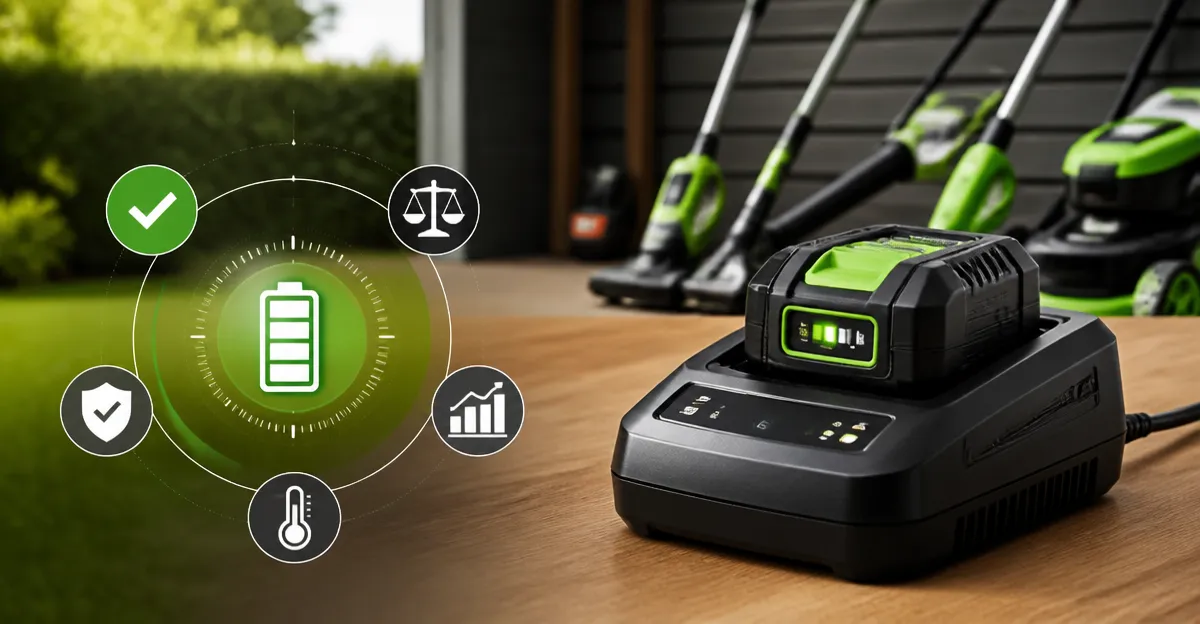
Rapid Chargers for Cordless Yard Tool Batteries: The Ultimate Guide to Pros, Cons, Battery Life & Safety
Introduction
This guide examines rapid charging solutions for cordless yard tool batteries. Readers will learn fundamental battery technology, how fast chargers differ from standard units, and which features influence performance and safety. The article also presents a curated selection of five highly rated chargers, each linked to its Amazon product page. By the end of the guide, one will be equipped to select a charger that matches specific tool requirements, budget constraints, and safety expectations.
Rapid chargers reduce downtime for leaf blowers, string trimmers, cordless drills, and mini chainsaws. Understanding the trade‑offs between speed, heat management, and battery longevity is essential for maintaining tool reliability. The following sections provide a structured approach to evaluating chargers, comparing specifications, and applying best‑practice charging techniques.
Background and Context
Most cordless yard tools operate on lithium‑ion (Li‑ion) cells rated at 12 V, 20 V, or 21 V. Li‑ion chemistry delivers high energy density and low self‑discharge, but it requires precise voltage and current control during charging. Over‑charging or charging at excessive current can accelerate cell degradation, increase heat, and pose safety hazards.
Manufacturers typically supply a standard charger that delivers 1 A or less. While safe, such chargers may require several hours to restore a depleted 2 Ah battery. Rapid chargers increase the charging current to 2 A or higher, shortening charge time to 40‑90 minutes depending on battery capacity. The increased current is managed by internal protection circuits that monitor temperature, voltage, and current flow.
Key concepts to grasp include:
- Charging Current (Amperes): Higher amperage reduces charge time but generates more heat.
- Voltage Compatibility: A charger must match the battery’s nominal voltage (12 V, 20 V, or 21 V).
- Connector Type: Most 20 V/21 V tools use a round barrel jack (5.5 mm × 2.5 mm or 2.1 mm).
- Safety Protections: Over‑charge, over‑current, short‑circuit, and temperature safeguards are mandatory for reliable operation.
Armed with this knowledge, readers can assess whether a rapid charger offers genuine value for their toolset.
Understanding Charger Categories
Rapid chargers fall into three broad categories: OEM‑compatible, universal, and brand‑specific high‑performance models. Each category presents distinct advantages.
- OEM‑compatible chargers replicate the specifications of the original equipment manufacturer. They often fit multiple battery models within the same brand family. Example: Black+Decker 20V Fast Charger is marketed as an OEM replacement for Black+Decker’s original 20 V charger.
- Universal chargers accept a range of voltages and connector sizes. They are useful for users who own tools from different brands but share similar battery formats. Example: Gonine 21V Lithium Battery Charger supports both 20 V and 21 V batteries across several manufacturers.
- Brand‑specific high‑performance chargers are engineered for a single tool line, offering optimized heat dissipation and faster charge cycles. Example: Hyper Tough 20V Fast Charger is designed exclusively for Hyper Tough batteries.
When selecting a charger, consider the degree of tool diversity, desired charge speed, and the importance of warranty support.
Product Recommendations
The following chargers have been chosen based on rating, price, and feature set. Each recommendation includes key specifications, user sentiment, and a direct link for purchase.
1. BLACK+DECKER 20V Battery Charger
BLACK+DECKER 20V Battery Charger offers compatibility with both 12 V MAX* and 20 V MAX* lithium‑ion slide packs. At a price of $22.99, it delivers a 1.5‑Ah charge in 40 minutes or less, as indicated by the green light indicator. The charger holds a 4.7‑star rating from over fifteen thousand reviews, with customers praising its rapid charge time and reliable performance after moving homes. Safety features include over‑charge indication and a compact form factor. This unit is ideal for users who already own BLACK+DECKER batteries and desire a quick‑charge solution without replacing existing accessories.
2. Black+Decker 20V Fast Charger
Black+Decker 20V Fast Charger functions as an OEM replacement and supports a wide range of Black+Decker battery models, including LBXR20, LBX4020, and LBXR2020. Priced at $21.99, it supplies 2 A output, charging a 2.0 Ah battery in 90 minutes or less. The charger incorporates multiple protection circuits and an LED status indicator that flashes green while charging and solid green when complete. Users highlight its compatibility with drill batteries, paint sprayer packs, and larger 6‑Ah batteries, noting the convenience of a single charger for diverse tools.
3. Gonine 21V Lithium Battery Charger
Gonine 21V Lithium Battery Charger is a universal charger priced at $14.07, making it the most affordable option in this guide. It accepts 20 V and 21 V batteries from brands such as Saker, Jujubean, SEYVUM, DINSHARE, and VTEK. The charger provides a 21 V output and includes an intelligent chip that accelerates charging by up to 30 % while maintaining overload protection. LED indicators display red during charging and green when finished. Reviewers commend its versatility and low cost, though they advise confirming the barrel‑jack size before purchase.
4. Hyper Tough 20V Fast Charger
Hyper Tough 20V Fast Charger commands a price of $25.99 and delivers 2 A current specifically for Hyper Tough 20 V lithium‑ion batteries. The charger features tri‑side heat dissipation, an LED system that transitions from red (charging) to green (full), and comprehensive safety protections. Customers report a dramatic reduction in charging time compared with the standard charger, emphasizing the value for frequent users of Hyper Tough tools.
5. Nden 21V Tool Battery Charger
Nden 21V Tool Battery Charger is the budget‑friendly choice at $9.85. It supplies 21 V DC through a standard round barrel connector and includes an intelligent chip for stable power delivery. The charger is compatible with a wide array of 20 V/21 V cordless tools, making it suitable for users who own multiple brands. Reviewers appreciate the fast shipping and reliable operation, though a few note that physical size may be a consideration for compact workspaces.
Comparison and Selection Guide
Choosing the optimal charger requires evaluating four primary criteria: voltage compatibility, charging current, safety features, and price. The table below summarizes how each product performs against these criteria.
| Product | Voltage Compatibility | Current (A) | Safety Protections | Price (USD) | Rating |
|---|---|---|---|---|---|
| BLACK+DECKER 20V Battery Charger | 12 V & 20 V | 1.5 | Over‑charge indicator, LED status | 22.99 | 4.7 |
| Black+Decker 20V Fast Charger | 20 V (multiple models) | 2.0 | Over‑charge, over‑current, short‑circuit, FCC/CE certified | 21.99 | 4.6 |
| Gonine 21V Lithium Battery Charger | 20 V & 21 V (universal) | ~1.5‑2.0 (fast mode) | Overload, short‑circuit, temperature control | 14.07 | 4.4 |
| Hyper Tough 20V Fast Charger | 20 V (Hyper Tough only) | 2.0 | Over‑charge, overload, short‑circuit, heat‑dissipation design | 25.99 | 4.4 |
| Nden 21V Tool Battery Charger | 20 V & 21 V (generic) | ~1.0‑1.5 | Overload, short‑circuit, temperature control | 9.85 | 4.4 |
For users who require the fastest possible charge for a single brand, the Hyper Tough 20V Fast Charger offers dedicated heat management and a 2 A output. Those who own multiple Black+Decker tools will benefit from the OEM‑compatible Black+Decker 20V Fast Charger, which supports a broad battery lineup. Budget‑conscious shoppers seeking universal compatibility should consider the Gonine 21V Lithium Battery Charger or the Nden 21V Tool Battery Charger.
Best Practices & Tips for Safe Rapid Charging
- Verify voltage and connector size before connecting a charger. Using a 21 V charger on a 12 V battery can cause irreversible damage.
- Charge in a well‑ventilated area to dissipate heat generated by higher amperage.
- Do not leave batteries on the charger beyond the indicated full‑charge state. LED indicators provide a reliable cue.
- Periodically inspect charger cables for wear or fraying. Damaged cables can lead to short‑circuit events.
- When charging multiple batteries, stagger start times to avoid simultaneous heat buildup.
- Store batteries at a moderate temperature (15‑25 °C) when not in use to preserve capacity.
Frequently Asked Questions
- Can a 20 V charger be used on a 21 V battery? Most chargers are designed for a specific nominal voltage. A 20 V charger may not provide sufficient voltage to fully charge a 21 V battery, leading to reduced runtime. Choose a charger that explicitly lists 21 V compatibility, such as the Gonine 21V Lithium Battery Charger.
- What is the safest charging current for a 2 Ah battery? A current of 1 A to 1.5 A is generally considered safe for a 2 Ah cell, providing a balance between speed and heat generation. Fast chargers delivering 2 A, like the Black+Decker 20V Fast Charger, incorporate thermal sensors to mitigate risk.
- Do LED indicators replace the need for a separate battery monitor? LED status lights convey charging progress but do not replace a dedicated battery health monitor. Users should still track cycle counts and capacity loss over time.
- Is it necessary to use the original charger supplied by the tool manufacturer? Original chargers guarantee compatibility, yet high‑quality third‑party chargers that meet OEM specifications can provide comparable safety and performance. The BLACK+DECKER 20V Battery Charger is an example of an OEM‑compatible alternative.
- How often should a charger be replaced? Chargers typically last several years if kept free of dust and moisture. Replace a charger that shows inconsistent LED behavior, excessive heat, or physical damage.
- Can I charge a battery while it is still installed in the tool? Some tools support in‑tool charging, but most rapid chargers require the battery to be removed to ensure proper airflow and safety.
- What warranty coverage is typical for these chargers? Most products in this guide include at least a one‑year warranty, with the Black+Decker 20V Fast Charger explicitly offering a one‑year quality service.
Conclusion
Rapid chargers significantly improve productivity for users of cordless yard tools by reducing downtime and maintaining battery health when proper safety measures are observed. By understanding voltage compatibility, charging current, and built‑in protection features, one can select a charger that aligns with tool inventory and budget. The five products highlighted in this guide represent a spectrum from brand‑specific high‑performance units to affordable universal adapters. Applying the best‑practice tips will ensure safe operation and extend the useful life of valuable Li‑ion batteries.
Products Featured in This Guide
BLACK+DECKER 20V Battery Charger
Price: $22.99 | Rating: 4.7/5 (15,150 reviews)
Featured for its dual 12 V/20 V compatibility, rapid 1.5 A charging, and strong customer satisfaction.
Black+Decker 20V Fast Charger
Price: $21.99 | Rating: 4.6/5 (302 reviews)
Featured for its OEM‑compatible design, 2 A output, and comprehensive safety certifications.
Gonine 21V Lithium Battery Charger
Price: $14.07 | Rating: 4.4/5 (249 reviews)
Featured for its universal 20 V/21 V compatibility, intelligent fast‑charge chip, and budget‑friendly price.
Hyper Tough 20V Fast Charger
Price: $25.99 | Rating: 4.4/5 (217 reviews)
Featured for its dedicated Hyper Tough design, 2 A output, and tri‑side heat‑dissipation system.
Nden 21V Tool Battery Charger
Price: $9.85 | Rating: 4.4/5 (25 reviews)
Featured for its low cost, universal 20 V/21 V compatibility, and intelligent safety chip.